Serratus Push Ups Tutorial

Serratus Push-Ups Tutorial

Variations for Strength

strength

What Is The Importance of Serratus Anterior Push-Ups?

When you hear the term “boxer muscles,” you most likely know that it’s referring to the serratus anterior. However you refer to it, it’s an important part of creating both stability and strength for your shoulders. A great way to strengthen the serratus anterior is by doing “serratus push-ups.” There is a variety of different ways in which to approach them. In today’s serratus push-ups tutorial video, Matt demonstrates 4 variations that help you tap into the strength required for greater access to postures that require the use of these “push” muscles. 

Why Are They Relevant To Your Yoga Practice?

Serratus push-ups are also commonly referred to as scapula push-ups. They are a wonderful and necessary part of your toolkit for both increased strength of your shoulders and mobility of the scapulae. The serratus anterior facilitates upward rotation of the scapulae whenever you take your arms into a position over your head. Upward rotation of the scapulae is necessary to take some of the work away from the trapezius. It also helps reduce the possibility of hypermobility in the glenohumeral joint.

In your physical yoga practice, this is relevant in postures like Downward-Facing Dog, Chair Pose, Crescent Lunge, and Handstand (just to name a few). Upward rotation of the scapulae is also helpful in your everyday life. Having the awareness to utilize the movement of the shoulder blades when reaching for objects overhead, for example, offers the same result. You maintain greater health and movement of the shoulder because you are recruiting the use of the serratus anterior muscles to create movement of the scapula.


Handstand and meditation online yoga classes

HANDSTAND & MEDITATION

ONLINE YOGA IMMERSION

BREAK THROUGH MENTAL & PHYSICAL BLOCKS

  • Learn the most effective drills to safely build your Handstand
  • Practice essential meditation techniques to break through mental barriers and build confidence
  • Improve focus and breath support right side up and upside down
  • Build strength and the necessary skills for balancing Handstand
  • 12 classes: All levels appropriate
  • Lifetime unlimited access to all
  • Attend livestream OR practice the replays any time that’s convenient for you

SALE PRICE: $168.00

MORE INFORMATION

SERRATUS ANTERIOR MUSCLES

These muscles run underneath your scapulae, then around to the ribcage: “The serratus anterior is ‘multi-headed’ and forms the lateral part of the chest wall, giving it a ‘serrated’ appearance.” Contracting these muscles creates the movement of the scapulae around your ribs (protraction). 

Long, Ray. The Key Muscles of Yoga. Bandha Yoga Publications, 2005. Pg. 162

WATCH THE VIDEO: SERRATUS PUSH-UPS TUTORIAL

NEXT TRAINING BEGINS FEBRUARY 2024 ENROLLMENT NOW OPEN!

THE 2 MAIN ACTIONS

In a serratus push-up, the 2 main actions are retraction and protraction of the scapulae.  

Retraction of the Scapulae

When you are performing one of the serratus push-up variations, it’s really your torso that moves towards the surface beneath you in order to create the retraction. In this case, the scapulae are not creating the movement. The focus here is the “push,” when you actually “push the floor away” in order to move into the next action in the movement (protraction).

Protraction of the Scapulae

Protraction creates a great deal of stability in your shoulder joint. When you take your arms overhead in your yoga practice, it’s likely that you will default into retraction (drawing your shoulder blades towards one another). If this is your intention, that’s fine, but let’s consider what that means in the context of Handstand. If the goal is to be straight up and down and stable in the posture, of course it requires a great deal of strength. It’s important then to be extremely intentional about creating protraction of the scapulae (pushing your shoulder blades away from one another). It’s in this “push” action that you recruit and rely on the serratus anterior muscles to support and align your body for the greatest amount of stability.

STRENGTH

ONLINE YOGA IMMERSION

Yoga for Strength: Strengthen Your Weaknesses • Maximize Your Physical Potential

  • 12 classes: Each class targets a specific muscle group
  • Strengthen your core, back, hips, shoulders, wrists, ankles, legs, and arms
  • Learn creative ways to strength train within the context of a yoga practice
  • Increase mobility by balancing your strength with oppositional muscle groups
  • Joyful accountability to help you reach your practice goals

SALE PRICE: $138.00 $128.00

MORE INFORMATION

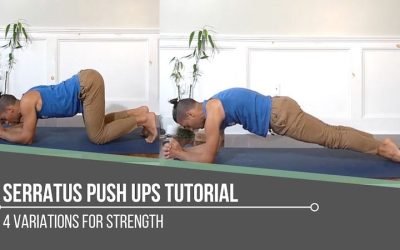
SERRATUS PUSH-UPS: 4 VARIATIONS FOR STRENGTH

There are specific cues for each scapular push-up variation that help you to maximize your potential to create strength.

Variation (Level 1)

  1. Place the forearms on the floor with your knees stacked under your hips
  2. Let the chest sink into the retracted scapulae
  3. Push the elbows into the ground until scapulae push apart (creating the 2nd phase of the push-up)

Variation (Level 2)

  1. Take your knees further away (more into a plank-like position)
  2. Execute the serratus push-ups 

Variation (Level 3)

  1. Plank on forearms with toes tucked
  2. Execute serratus push-ups

Variation (Level 4)

  1. Plank on forearms with toes pointed
  2. Round your back
  3. Bring ankle bones together
  4. Execute serratus push-ups

A SIMPLE FORMULA FOR STRENGTH

Consistency and progression are the winners here. It’s important to explore all 4 of these serratus push-up variations to find out what is most suitable for you. Matt suggests a conservative number of repetitions while you maintain integrity in your form. Once you feel like you are able to increase the number of repetitions, you may progress to the next level or variation (doing only a conservative amount) in order to become aware of whether or not you wish to return to the previous level, possibly increasing the number of repetitions. Exploring in this way over time is a recipe for increased strength in the serratus anterior and increased stability of the scapulae.

There is still time to explore more of this in Matt’s current immersion, Handstand & Meditation.

See you on the mat!

The 200 Hr. Teacher Training: Click Here to See the Next Start Date

The 300 Hr. Advanced Teacher Training: Click Here to See the Next Start Date

Article by Trish Curling

Video Extracted From: Handstand & Meditation Immersion

CHOOSE YOUR PATH

NEXT TRAINING BEGINS FEBRUARY 2024 ENROLLMENT NOW OPEN!

Continue Learning
Serratus Push Ups Tutorial

Serratus Push Ups Tutorial

Serratus Push-Ups Tutorial Variations for StrengthstrengthWhat Is The Importance of Serratus Anterior Push-Ups? When you hear the term “boxer muscles,” you most likely know that it’s referring to the serratus anterior. However you refer to it, it's an important part...
read more
SHORTEN TO LENGTHEN YOUR STANDING SPLITS

SHORTEN TO LENGTHEN YOUR STANDING SPLITS

SHORTEN TO LENGTHEN YOUR STANDING SPLITS  INCREASE FLEXIBILITY WITH THIS TECHNIQUEHANUMANASANASHORTEN TO LENGTHEN What does shorten to lengthen your standing splits even mean? Does that even make sense? At first thought it may seem counterintuitive that if you want to...
read more
Open Your Heart in Camel Pose

Open Your Heart in Camel Pose

OPEN YOUR HEART IN CAMEL POSE  Layer These TechniquesustrasanaOPEN YOUR HEARTThere's such a majestic and robust quality when it comes to heart openers in a physical yoga practice. In order to open your heart and gain greater access to a backbend such as Camel Pose,...

read more
Take Flight in Crow Pose

Take Flight in Crow Pose

TAKE FLIGHT IN CROW POSE Strengthen Your WristsKAKASANAWHAT IS THE SECRET TO TAKING FLIGHT IN CROW POSE?In order to take flight in Crow Pose, it may seem obvious that a great deal of emphasis needs to be placed on your hands, but what often happens is that a great...

read more
KICK UP INTO HANDSTAND

KICK UP INTO HANDSTAND

KICK UP INTO HANDSTAND  Master 3 Key Actions alignmentHANDSTAND—3 KEY ACTIONS “Squeeze in, turn in, tuck the tail.” These are the 3 key actions for handstands that Matt explains are a must. These may sound like simple cues, and they may even be easy to execute if...

read more
EKA PADA BAKASANA II

EKA PADA BAKASANA II

EKA PADA BAKASANA II The Essence of Push & PullTHE GUNASTHE GUNAS—The essence of push & pullWe’ve all experienced the essence of push and pull in one way or another. Its presence is evident all around and within us. We all experience the rise and fall, the...

read more

THE FREE TECHNIQUE PACK

When You Subscribe, You Will Get Instant Access to

  • the Technique Pack: 15 yoga pose breakdowns
  • exclusive online course discounts
  • exclusive blogs and videos
  • This field is for validation purposes and should be left unchanged.

SHORTEN TO LENGTHEN YOUR STANDING SPLITS

SHORTEN TO LENGTHEN YOUR STANDING SPLITS 

INCREASE FLEXIBILITY WITH THIS TECHNIQUE

HANUMANASANA

SHORTEN TO LENGTHEN

What does shorten to lengthen your standing splits even mean? Does that even make sense? At first thought it may seem counterintuitive that if you want to increase your flexibility, you need to shorten. What we’re talking about is shortening muscles in order to find greater length in your hamstrings for this posture. There is a specific technique that supports your ability to increase your flexibility, all while building strength and integrity in standing splits.

PASSIVE VS. ACTIVE STRETCHING

Any variation of splits requires a great deal of flexibility, and because lengthening muscles is non-negotiable to execute this posture, a common go-to strategy in your yoga practice may be to select postures and techniques that passively assist you in this endeavor. This passive assistance might involve using a yoga strap, a wall, and/or the floor to sink into the forces of gravity. These can be effective stretching methods at various times, but if you’re interested not only in lengthening but in the overall health of the muscles that are lengthening, then please introduce yourself to the concept of a Facilitated Stretch (more on this in a bit). This technique asks you to shorten in order to lengthen. A facilitated stretch requires you to be a more active participant in creating stronger and healthier flexibility in your body.


Handstand and meditation online yoga classes

HANDSTAND & MEDITATION

ONLINE YOGA IMMERSION

BREAK THROUGH MENTAL & PHYSICAL BLOCKS

  • Learn the most effective drills to safely build your Handstand
  • Practice essential meditation techniques to break through mental barriers and build confidence
  • Improve focus and breath support right side up and upside down
  • Build strength and the necessary skills for balancing Handstand
  • 12 classes: All levels appropriate
  • Lifetime unlimited access to all
  • Attend livestream OR practice the replays any time that’s convenient for you

SALE PRICE: $168.00

MORE INFORMATION

FLEXIBILITY? STRENGTH? or BOTH?

In order to achieve standing splits, there must be a level of flexibility in your hamstrings, adductor magnus, and the hip flexors. There must also be an awareness around the movement of your pelvis. However, an element that often gets overlooked is the fact that a great deal of strength is required for the posture. 

When preparing for standing splits, Matt explains that the goal is to keep the hamstrings engaged through the entire range of motion. How is this possible? This is where the awareness of the articulation of your pelvis is key. In the video, Matt demonstrates the importance of slowing the tipping of the pelvis on the way down and also tucking the sit bone of the standing leg downwards (this will create more of a posterior tilt of the pelvis).

The rest of the body should stay in one piece to ensure that the movement is occurring from the hamstrings of the standing leg—everywhere else is stable and immobile. This may take some time, due to the patterns you may have created in your body.

WATCH THE VIDEO: SHORTEN TO LENGTHEN YOUR STANDING SPLITS

NEXT TRAINING BEGINS FEBRUARY 2024 ENROLLMENT NOW OPEN!

YOUR BODY’S TENDENCIES

Our bodies just love the familiar, so it will take an incredible amount of focus and awareness in order to go into the places in your body that require more length and strength. This is in fact how you will unlock the posture. You will not only achieve the aesthetic of the posture but also move in the direction of better balance in your body. This also means a reduced risk of injury. Matt always encourages a more intelligent and methodical approach to your practice as a whole, but this method must also be applied as you approach each posture. 

No matter your approach, Splits, Standing Splits, Hanumanasana are very demanding and deep postures that may put you at a higher risk, so the activation of muscles is key. This brings us back to the concept of a Facilitated Stretch. What is it, and how is it implemented?

Online yoga to improve mobility

MOBILITY

ONLINE YOGA IMMERSION

  • Key techniques to increase flexibility
  • Strength development for mobility and range of motion
  • Learn postures: Hanumanasana (Splits), Extended Side Plank
  • Active and passive mobility for shoulders, hips, and spine
  • Improve spinal twists, heart openers, shoulder openers, and hip openers
  • Find greater ease in seated postures
  • Improve mobility and posture off the mat
  • When and how to do active, passive, and isometric stretching

$148.00

MORE INFORMATION

FACILITATED STRETCH

If you’re just starting your journey of practicing with Matt, please believe me when I say that you will become the best of pals with this concept. Is it challenging at times? YES, YES, and YES I said that multiple times, but is it effective? YES, YES, and YES again!

A facilitated stretch is when a muscle is engaged while it is in a lengthened position. We have something called Golgi tendon organs which communicate muscle tension back to the brain. When a muscle is both engaged and lengthened, the brain will receive that information and will in turn send a signal back to the muscle that it is safe, therefore allowing it to lengthen more. This is in fact the key to the development of increased flexibility. This is also in fact extremely effective for those of you who may be hypermobile. It creates a sense of control and awareness around your end ranges in a particular posture. We have the ability to facilitate this tension by the articulations we might create with, for example, an action of the pelvis and/or the directional pull of a particular joint against a surface, prop, or other part of our body. Staying closer to a safer amount of activation usually means placing roughly about 20% of effort (or less) into the activation. At the root of it all is your breath, so keep this in mind as we look at the steps Matt provides in order to set up Standing Splits at the wall.  

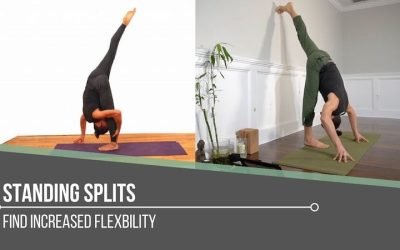
STANDING SPLITS AT THE WALL

  1. Use hands as a base of support
  2. Look towards the wall
  3. Lift right heel (shortens the back line)
  4. Turn pelvis closed and turn inner heel of the lifted leg to the sky
  5. Straighten through inner heel of the lifted leg to the sky
  6. Lower heel of the standing leg back down
  7. Lean more into fingers and toes as top leg is straightened

*Here’s the opportunity to tap into the facilitated stretch of the standing leg:

8.  Standing leg (in this case the right leg) is not passive—microtuck the sit bone down towards your heel so that the hamstrings are engaged

If it feels like you’re strengthening rather than stretching, then you’re on the right track. This is in fact the sensation of a facilitated stretch and what actually increases your flexibility. Rather than causing alarm to your body, it will feel safe to release and lengthen.

A DIRECT LINK TO HANDSTAND

Safety breeds confidence, and the beautiful thing about incorporating techniques like a facilitated stretch into your yoga practice is that you feel both prepared and confident to explore a variety of postures. This exploration allows space for you to work towards postures that may feel “intimidating” or even “inaccessible.”  

The specific techniques that Matt has demonstrated for Standing Splits create a direct link to Handstand. The direct link comes from what is required in regard to the setup. Getting into Handstand from the ground up requires a great deal of flexibility and strength. You can find out more about the crossover between these two postures in Matt’s current immersion, Handstand & Meditation.

See you on the mat!

The 200 Hr. Teacher Training: Click Here to See the Next Start Date

The 300 Hr. Advanced Teacher Training: Click Here to See the Next Start Date

Article by Trish Curling

Video Extracted From: Mobility Immersion

CHOOSE YOUR PATH

NEXT TRAINING BEGINS FEBRUARY 2024 ENROLLMENT NOW OPEN!

Continue Learning

Serratus Push Ups Tutorial

Serratus Push Ups Tutorial

Serratus Push-Ups Tutorial Variations for StrengthstrengthWhat Is The Importance of Serratus Anterior Push-Ups? When you hear the term “boxer muscles,” you most likely know that it’s referring to the serratus anterior. However you refer to it, it's an important part...

read more
SHORTEN TO LENGTHEN YOUR STANDING SPLITS

SHORTEN TO LENGTHEN YOUR STANDING SPLITS

SHORTEN TO LENGTHEN YOUR STANDING SPLITS  INCREASE FLEXIBILITY WITH THIS TECHNIQUEHANUMANASANASHORTEN TO LENGTHEN What does shorten to lengthen your standing splits even mean? Does that even make sense? At first thought it may seem counterintuitive that if you want to...

read more
Open Your Heart in Camel Pose

Open Your Heart in Camel Pose

OPEN YOUR HEART IN CAMEL POSE  Layer These TechniquesustrasanaOPEN YOUR HEARTThere's such a majestic and robust quality when it comes to heart openers in a physical yoga practice. In order to open your heart and gain greater access to a backbend such as Camel Pose,...

read more
Take Flight in Crow Pose

Take Flight in Crow Pose

TAKE FLIGHT IN CROW POSE Strengthen Your WristsKAKASANAWHAT IS THE SECRET TO TAKING FLIGHT IN CROW POSE?In order to take flight in Crow Pose, it may seem obvious that a great deal of emphasis needs to be placed on your hands, but what often happens is that a great...

read more
KICK UP INTO HANDSTAND

KICK UP INTO HANDSTAND

KICK UP INTO HANDSTAND  Master 3 Key Actions alignmentHANDSTAND—3 KEY ACTIONS “Squeeze in, turn in, tuck the tail.” These are the 3 key actions for handstands that Matt explains are a must. These may sound like simple cues, and they may even be easy to execute if...

read more
EKA PADA BAKASANA II

EKA PADA BAKASANA II

EKA PADA BAKASANA II The Essence of Push & PullTHE GUNASTHE GUNAS—The essence of push & pullWe’ve all experienced the essence of push and pull in one way or another. Its presence is evident all around and within us. We all experience the rise and fall, the...

read more

THE FREE TECHNIQUE PACK

When You Subscribe, You Will Get Instant Access to

  • the Technique Pack: 15 yoga pose breakdowns
  • exclusive online course discounts
  • exclusive blogs and videos
  • This field is for validation purposes and should be left unchanged.

Open Your Heart in Camel Pose

OPEN YOUR HEART IN

CAMEL POSE 

Layer These Techniques

ustrasana

OPEN YOUR HEART

There’s such a majestic and robust quality when it comes to heart openers in a physical yoga practice. In order to open your heart and gain greater access to a backbend such as Camel Pose, there are specific techniques you can use. Even with their majestic qualities, your experience with heart openers can vary. They can be wonderfully satisfying or extremely difficult. It’s important to be aware of your individual circumstances at the time of moving in and/or out of any posture that calls for extension of the spine. In opening your heart in Camel Pose, there is potential to shift your experience with the posture. The techniques that Matt offers create this possibility to re-pattern what takes place in your body.  

    back bending online yoga and anatomy

    ANATOMY OF THE HEART

    JUNE 2022 Immersion

    • Technique to expand and deepen your backbends
    • Foundations and preparatory postures to set you up for success
    • Anatomy education to prime the nervous system
    • Themes to cultivate the appropriate mindset for heart opening
    • 12 Classes: 6 focused on anatomy, 6 themed for the heart
    • Unlock a wide range of postures including: Bow Pose, Camel, Full Wheel, King Dancer, King Cobra, King Pigeon, and more
    • Lifetime unlimited access to all
    • Attend livestream OR practice the replays any time that’s convenient for you

    $168.00 $148.00

    MORE INFORMATION


    BOWING THE SPINE

    If you’ve practiced with Matt before, then you’re very familiar with the terminology “bowing the spine” when discussing backbends, or heart openers. Bowing the spine provides an immediate visual that most people can resonate with, and it is helpful in developing an awareness of the experience of what a backbend looks and feels like. You can just imagine the ease of flexibility in the spine, all while maintaining a strength and integrity of the spine during execution.

    Bowing the spine teaches you to move everything forward first, which leads to opening up.

    Matt explains that in a backbend, instead of just leaning back or arching the spine, you want to think about opening the front of the spine. When you learn how to do this accurately, the discs of the spine slide forward, which is really important. If they don’t slide forward, then you’re just pushing the discs down on the back side of the spine, which will put too much pressure on the discs. Adding this pressure can cause many problems, including pain due to the discs bulging and possibly hitting a nerve, which can radiate in multiple directions of the body and cause issues in other areas. Layering on techniques both provides a better awareness of what is actually taking place in your body and promotes safer execution in heart openers.

    WATCH THE VIDEO: CAMEL POSE: SHOULDER TECHNIQUE

    NEXT TRAINING BEGINS FEBRUARY 2024 ENROLLMENT NOW OPEN!
    NEXT TRAINING BEGINS FEBRUARY 2024 ENROLLMENT NOW OPEN!

    THE CHROMATIC WAY

    Matt’s development of the Chromatic approach in yoga involves not just the layering on of postures in a sequence but indeed the layering on of techniques within each posture in order to maximize benefit and to minimize injury and pain. When you start to approach your yoga practice with this methodical mindset, the body eventually becomes free and aware to create these actions with less thought.

    LAYERING POSTURES TO PREPARE

    Matt frequently uses postures like Cobra Pose, where he teaches the fundamentals of how to “bow the spine.” You will also find that he uses Chair Pose in this layering process.  

    Within these postures, we build the pattern in the body of actions such as retracting the shoulder blades while not only taking the chest/heart forward but also lifting the rib cage upwards. Getting comfortable with these actions activates muscles like the rhomboids (during the retraction) and the abdominals (when lifting the rib cage) and also develops the neuromuscular patterning in your body so that these actions feel more natural and become a more automatic response when preparing for and executing backbends.

    back bending online yoga and anatomy

    ANATOMY OF THE HEART

    JUNE 2022 Immersion

    • Technique to expand and deepen your backbends
    • Foundations and preparatory postures to set you up for success
    • Anatomy education to prime the nervous system
    • Themes to cultivate the appropriate mindset for heart opening
    • 12 Classes: 6 focused on anatomy, 6 themed for the heart
    • Unlock a wide range of postures including: Bow Pose, Camel, Full Wheel, King Dancer, King Cobra, King Pigeon, and more
    • Lifetime unlimited access to all
    • Attend livestream OR practice the replays any time that’s convenient for you

    $168.00 $148.00

    MORE INFORMATION


    KEY ACTIONS FOR CAMEL POSE ENTRY

    Even before considering the traditional execution of Camel Pose, Matt takes you through what he often refers to as “Camel Pose Preparation” or “Half Camel Pose.” When preparing, it’s not just about entry into the pose; the “exiting” of the posture is also extremely important.

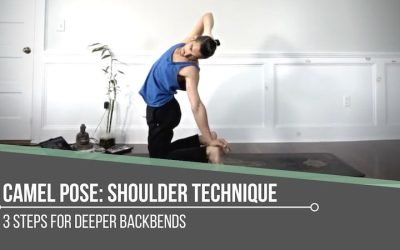
    In today’s video, Matt provides the key steps and layering process when entering Camel Pose Preparation from the left side:

    1. Tuck your toes onto your mat with feet wider than your hips, so that when you sit back, you can access your heel with your left hand
    2. Retract your left shoulder (*Pay close attention here, as you will not just be drawing your left shoulder blade in towards your midline. You first lift your shoulder up, then draw it in towards the midline, and finally, send the bottom tip of your shoulder blade up towards the sky)
    3. Next in the layering process, after this action of retraction, place your left palm on your heel with the thumb facing out
    4. Push the right rib cage forward and up 
    5. Place your right hand behind your head. Alternatively, Matt advises using your right hand to pick up your right ribs (*this will encourage an arched position in your low back, which is the desired positioning)
    6. Layer on a push downward into your left heel with your hand, encouraging that lift of the right side rib cage further up to the sky
    7. Finally, look down towards your left foot

    A SAFE EXIT FROM CAMEL POSE

    As I mentioned before, Matt emphasizes the exit just as much as the entrance. It’s important to note that we don’t change anything. We try to maintain the arch in the spine for as long as possible in order the spine time to adjust to the new shape (relengthening once out of the posture).

    Here are the steps:

    1.  Your hips slowly go back towards your heels, all while keeping the chest lifted
    2.  As you sit back down onto your feet, you can slowly reduce the arch in your spine until it is in a more lengthened position
    3. Take the steps to enter into “Camel Pose Preparation” on the other side.

    Taking this Chromatic approach keeps you in the physical practice: You are steered more towards awareness of your individual experience within each posture. Exploring Camel Pose Preparation also allows you to experience what is happening on each side of your body. This helps you step closer to what your body actually needs. Do you need to draw more awareness to the retraction? The arch of the spine? Sending your rib cage forward and up? You are simultaneously the student and the teacher within your own body. Matt guides your yoga practice with the layering of actions so that you can be fully within the experience of your own body.

    Taking this approach means that you will broaden your knowledge, expand your practice, and most definitely open your heart!

    See you on the mat!

    The 200 Hr. Teacher Training: Click Here to See The Next Start Date

    The 300 Hr. Advanced Teacher Training: Click Here to See The Next Start Date

    Article by Trish Curling

    Video Extracted From: Heart Openers: Yoga Backbends Immersion

    CHOOSE YOUR PATH

    NEXT TRAINING BEGINS FEBRUARY 2024 ENROLLMENT NOW OPEN!
    NEXT TRAINING BEGINS FEBRUARY 2024 ENROLLMENT NOW OPEN!

    Continue Learning

    Serratus Push Ups Tutorial

    Serratus Push Ups Tutorial

    Serratus Push-Ups Tutorial Variations for StrengthstrengthWhat Is The Importance of Serratus Anterior Push-Ups? When you hear the term “boxer muscles,” you most likely know that it’s referring to the serratus anterior. However you refer to it, it's an important part...

    read more
    SHORTEN TO LENGTHEN YOUR STANDING SPLITS

    SHORTEN TO LENGTHEN YOUR STANDING SPLITS

    SHORTEN TO LENGTHEN YOUR STANDING SPLITS  INCREASE FLEXIBILITY WITH THIS TECHNIQUEHANUMANASANASHORTEN TO LENGTHEN What does shorten to lengthen your standing splits even mean? Does that even make sense? At first thought it may seem counterintuitive that if you want to...

    read more
    Open Your Heart in Camel Pose

    Open Your Heart in Camel Pose

    OPEN YOUR HEART IN CAMEL POSE  Layer These TechniquesustrasanaOPEN YOUR HEARTThere's such a majestic and robust quality when it comes to heart openers in a physical yoga practice. In order to open your heart and gain greater access to a backbend such as Camel Pose,...

    read more
    Take Flight in Crow Pose

    Take Flight in Crow Pose

    TAKE FLIGHT IN CROW POSE Strengthen Your WristsKAKASANAWHAT IS THE SECRET TO TAKING FLIGHT IN CROW POSE?In order to take flight in Crow Pose, it may seem obvious that a great deal of emphasis needs to be placed on your hands, but what often happens is that a great...

    read more
    KICK UP INTO HANDSTAND

    KICK UP INTO HANDSTAND

    KICK UP INTO HANDSTAND  Master 3 Key Actions alignmentHANDSTAND—3 KEY ACTIONS “Squeeze in, turn in, tuck the tail.” These are the 3 key actions for handstands that Matt explains are a must. These may sound like simple cues, and they may even be easy to execute if...

    read more
    EKA PADA BAKASANA II

    EKA PADA BAKASANA II

    EKA PADA BAKASANA II The Essence of Push & PullTHE GUNASTHE GUNAS—The essence of push & pullWe’ve all experienced the essence of push and pull in one way or another. Its presence is evident all around and within us. We all experience the rise and fall, the...

    read more

    THE FREE TECHNIQUE PACK

    When You Subscribe, You Will Get Instant Access to

    • the Technique Pack: 15 yoga pose breakdowns
    • exclusive online course discounts
    • exclusive blogs and videos
    • This field is for validation purposes and should be left unchanged.

    Take Flight in Crow Pose

    TAKE FLIGHT IN CROW POSE

    Strengthen Your Wrists

    KAKASANA

    WHAT IS THE SECRET TO TAKING FLIGHT IN CROW POSE?

    In order to take flight in Crow Pose, it may seem obvious that a great deal of emphasis needs to be placed on your hands, but what often happens is that a great deal of attention is placed elsewhere.

    When you think about Crow Pose—Bakasana—you may first think about what you need to do to either strengthen and/or activate the core. This is true, but how often do you think about what is necessary for your hands, wrists, and forearms? This part of your body plays a vital role not only in whether you will find enough strength to sustain the posture for any length of time but also in protecting your wrists overall.  

    A great deal of time is spent in wrist extension in yoga. Most commonly, you see varying degrees of this in postures like the following: 

    • Variations of Plank/Vasisthasana 
    • Chaturanga Dandasana 
    • Fallen Angel (Devaduuta Panna Asana)
    • Variations of Crow (Bakasana) 

    Matt talks a lot about starting postures from the ground up, and in Bakasana, this couldn’t be more true. You are balancing your entire body weight on your hands/wrists, so creating a solid foundation with your hands/wrists/forearms is non-negotiable. There are also actions in the hands that are mimicked/duplicated in the rest of your body as you layer on each action in the posture. You will see how everything is so closely related in Matt’s demonstration.

      Handstand and meditation online yoga classes

      HANDSTAND & MEDITATION

      ONLINE YOGA IMMERSION

      BREAK THROUGH MENTAL & PHYSICAL BLOCKS

      • Learn the most effective drills to safely build your Handstand
      • Practice essential meditation techniques to break through mental barriers and build confidence
      • Improve focus and breath support right side up and upside down
      • Build strength and the necessary skills for balancing Handstand
      • 12 classes: All levels appropriate
      • Lifetime unlimited access to all
      • Attend livestream OR practice the replays any time that’s convenient for you

      SALE PRICE: $168.00

      MORE INFORMATION

      THE BALANCE BETWEEN WRIST FLEXORS AND EXTENSORS

      When you understand how your body is working in each posture, it becomes a lot easier to see exactly how much everything is connected and how that both influences and supports the rest of your body parts in activating and responding the way you would like and need them to for stronger execution.

      Because you spend a lot of time in wrist extension in yoga, the wrist extensors (which are located on the back side of the forearms) are often shortened, and the flexors of the wrist (located on the front of the forearms) are in a more lengthened position. It’s imperative that these muscles be strong enough to, as Matt puts it, “apply the brakes” in arm balances. 

      Sending your weight forward is required in Crow Pose, so the strength of the “opposing action,” or creating an eccentric contraction of the flexors of the wrist to almost pull you back (that “application of the brakes” if you will), is in essence doing the work of keeping you balanced in the pose. Without this opposition or strength of the wrist flexors, you would just continue to go forward and then downward with gravity and eventually fall.

      So how do you activate and strengthen the flexors of the wrist? If you’ve practiced with Matt before, you’ll know that he often refers to creating a “suction cupping” of space, or a Hasta Bandha in the hands (an energetic hollow-like quality in the center of the palms). 

      “Hasta Bandha (Hand Lock) assists energy up through the soft center of your palms to bring strength and stability to your arms and upper body.”

      Ekhar, Esther, The Bandha Approach You Haven’t Tried—That Could Change Everything, Yoga Journal, February 28, 2018

      FOCUS ON YOUR HANDS

      In Crow Pose and other arm balances like it, the more you lean forward, the more you are required to grip the fingers into the ground in order to achieve the appropriate activation.

      Let’s look at some of the anatomy first.

      Your carpals are all of the tiny bones at the wrist (base of the palm), and the carpal tunnels are the space for the nerves to go through.

      When it comes to the hands in Crow Pose and other arm balances, we want to be lighter in the carpals (with less pressure, pulled away from the ground, due to the nerve lines that are present). In opposition to this, we want to get stronger and push into the ground at the head of the metacarpals (this is the surface/place you might describe as the knuckles or where the fingers [phalanges] meet the upper portion of the palm.)

      You achieve this action by drawing the pinky and the thumb towards each other and down into the ground at the same time. This action can also be described as adduction (pulling in towards the midline of the palm). At the same time, the 3 fingers (pad of the index, middle, and pinky) are also pulling towards the palm of the hand.

      This is creating a generous amount of activation and therefore strengthening of the flexors of the wrist (flexor digitorum profundus and superficialis). Although there are many other muscles involved (both flexors and extensors) that are co-activating, these are 2 that are great to keep in mind because the flexor digitorum profundus attaches all the way down to the fingers. This muscle also works in conjunction with the flexor carpi radialis and the flexor digitorum superficialis (as previously mentioned).  

      This fact demonstrates how essential it is, for your practice, to get into deeper awareness and connection with your body in an anatomical sense. This reinforces that nothing works in isolation and that one part of the body, one action, creates a domino effect for other activations, movements, and strengthening to occur.

      WATCH THE VIDEO: STRENGTHEN YOUR WRISTS FOR CROW POSE

      NEXT TRAINING BEGINS FEBRUARY 2024 ENROLLMENT NOW OPEN!
      NEXT TRAINING BEGINS FEBRUARY 2024 ENROLLMENT NOW OPEN!

      STRENGTHEN YOUR WRISTS IN CROW POSE WITH BLOCKS

      Let’s now take the deeper awareness and solid foundation of the hands and create the domino effect with the rest of the body in Crow Pose. In today’s video, Matt demonstrates how helpful blocks are when it comes to strengthening the flexors of the wrist. If flying is not your thing, or it’s just not your thing within a specific practice, you can still work on strengthening the flexors of the wrist by using a set of yoga blocks under your feet and leaning your bodyweight for more extension in the wrists.

      Here are the steps Matt outlines in today’s video:

      1. Place your feet up on the blocks
      2. Take your hands out in front, grip the ground with fingers (using all of the actions previously outlined) 
      3. Place knees outside of the arms and squeeze into arms (mimicking the action of the pinky and thumb drawing towards one another)
      4. Lift bum up to sky
      5. Lean bodyweight forward (increased wrist extension and eccentric contraction of the flexors)
      6. *Now bring your awareness back to the hands; play with the fingers—grip the ground, press through metacarpals, lean forward, and keep strong in the flexors of the wrist 
      7. Bonus is to lift the heels of feet towards bum to fly
      Online yoga to improve mobility

      MOBILITY

      ONLINE YOGA IMMERSION

      • Key techniques to increase flexibility
      • Strength development for mobility and range of motion
      • Learn postures: Hanumanasana (Splits), Extended Side Plank
      • Active and passive mobility for shoulders, hips, and spine
      • Improve spinal twists, heart openers, shoulder openers, and hip openers
      • Find greater ease in seated postures
      • Improve mobility and posture off the mat
      • When and how to do active, passive, and isometric stretching

      $148.00

      MORE INFORMATION

      THE BIG PICTURE—TAKE FLIGHT IN CROW POSE

      1.  Squeeze knees into the arms
      2.  Protract the shoulder blades 
      3.  Grip fingers into the ground

      Inviting in what may be some new actions to this posture, or to any other posture where the wrists are in extension in your physical yoga practice, helps to create a new muscular pattern. Repeating these actions will help your brain allow you to more easily default to these actions and therefore find the strength, ease, and lightness that’s desired in any arm balance.

        PARALLELS BETWEEN CROW POSE & HANDSTAND

        The beautiful thing about creating these patterns in your body and practicing the proper mechanics in Crow Pose is that these same mechanics translate quite well into other arm balances. 

        If you take a look at my previous article,  Kick Up Into Handstand, you’ll see exactly how Matt guides you through the same preparation for the wrists and forearms. You’ll see the importance of gripping the ground, the same alignment for the forearms, and the negotiation of the shift in weight required to balance (the balance of strength between the wrist flexors and extensors)—the same actions and techniques that help you to take flight in Crow Pose are the same fundamentals that help you see success and that assist with the crossover from one arm balance to another.

        Matt’s next Immersion, Handstand and Meditation, offers you an incredible opportunity to work on these fundamentals time and time again. You can also dive deeper into these teachings in his next 200 & 300 Hour Teacher Trainings.

          CHOOSE YOUR PATH

          NEXT TRAINING BEGINS FEBRUARY 2024 ENROLLMENT NOW OPEN!
          NEXT TRAINING BEGINS FEBRUARY 2024 ENROLLMENT NOW OPEN!

          Continue Learning

          Serratus Push Ups Tutorial

          Serratus Push Ups Tutorial

          Serratus Push-Ups Tutorial Variations for StrengthstrengthWhat Is The Importance of Serratus Anterior Push-Ups? When you hear the term “boxer muscles,” you most likely know that it’s referring to the serratus anterior. However you refer to it, it's an important part...

          read more
          SHORTEN TO LENGTHEN YOUR STANDING SPLITS

          SHORTEN TO LENGTHEN YOUR STANDING SPLITS

          SHORTEN TO LENGTHEN YOUR STANDING SPLITS  INCREASE FLEXIBILITY WITH THIS TECHNIQUEHANUMANASANASHORTEN TO LENGTHEN What does shorten to lengthen your standing splits even mean? Does that even make sense? At first thought it may seem counterintuitive that if you want to...

          read more
          Open Your Heart in Camel Pose

          Open Your Heart in Camel Pose

          OPEN YOUR HEART IN CAMEL POSE  Layer These TechniquesustrasanaOPEN YOUR HEARTThere's such a majestic and robust quality when it comes to heart openers in a physical yoga practice. In order to open your heart and gain greater access to a backbend such as Camel Pose,...

          read more
          Take Flight in Crow Pose

          Take Flight in Crow Pose

          TAKE FLIGHT IN CROW POSE Strengthen Your WristsKAKASANAWHAT IS THE SECRET TO TAKING FLIGHT IN CROW POSE?In order to take flight in Crow Pose, it may seem obvious that a great deal of emphasis needs to be placed on your hands, but what often happens is that a great...

          read more
          KICK UP INTO HANDSTAND

          KICK UP INTO HANDSTAND

          KICK UP INTO HANDSTAND  Master 3 Key Actions alignmentHANDSTAND—3 KEY ACTIONS “Squeeze in, turn in, tuck the tail.” These are the 3 key actions for handstands that Matt explains are a must. These may sound like simple cues, and they may even be easy to execute if...

          read more
          EKA PADA BAKASANA II

          EKA PADA BAKASANA II

          EKA PADA BAKASANA II The Essence of Push & PullTHE GUNASTHE GUNAS—The essence of push & pullWe’ve all experienced the essence of push and pull in one way or another. Its presence is evident all around and within us. We all experience the rise and fall, the...

          read more

          THE FREE TECHNIQUE PACK

          When You Subscribe, You Will Get Instant Access to

          • the Technique Pack: 15 yoga pose breakdowns
          • exclusive online course discounts
          • exclusive blogs and videos
          • This field is for validation purposes and should be left unchanged.

          KICK UP INTO HANDSTAND

          KICK UP INTO

          HANDSTAND 

          Master 3 Key Actions 

          alignment

          HANDSTAND—3 KEY ACTIONS

          “Squeeze in, turn in, tuck the tail.” These are the 3 key actions for handstands that Matt explains are a must. These may sound like simple cues, and they may even be easy to execute if you’ve already mastered kicking up into a handstand; however, if the pose is brand new and/or you’ve been working at it but still can’t “crack the code,” doing these 3 key actions in addition to all the other steps to prepare yourself may be what you’re missing. Layering on the specific techniques and muscle activations that Matt lays out for you is an essential part of your journey to kicking up into Handstand.  

          It’s impossible to skip the steps required when the intent is to kick up into a handstand position. This actually pertains to any posture, but if you’ve practiced with Matt before, you’ll know how much he stresses that it’s the foundations and the repetition of those foundations that really prepare the body for the desired outcomes. When you repeat these actions over and over again, you build the patterns into your body so that when it comes time for more robust movements and shapes, your body will respond.


          Handstand and meditation online yoga classes

          HANDSTAND & MEDITATION

          ONLINE YOGA IMMERSION

          BREAK THROUGH MENTAL & PHYSICAL BLOCKS

          • Learn the most effective drills to safely build your Handstand
          • Practice essential meditation techniques to break through mental barriers and build confidence
          • Improve focus and breath support right side up and upside down
          • Build strength and the necessary skills for balancing Handstand
          • 12 classes: All levels appropriate
          • Lifetime unlimited access to all
          • Attend livestream OR practice the replays any time that’s convenient for you

          SALE PRICE: $168.00

          MORE INFORMATION

          HANDSTAND PREPARATION 1 & 2

          Here are the steps for Handstand Preparation 1: 

          1. Place your hands on the ground
          2. Set up your blocks behind your forearms
          3. Straighten your elbows 
          4. Elevate the scapulae (push the floor away and bring your shoulders up to your ears)
          5. Lift your heels as high as you can

          Handstand Preparation 2 is a continuation of the process and includes lifting one leg up.

          Here are the steps:

          1. Inner leg lifts up to the sky as high as you can
          2. Look up to the lifted leg; when you do this, it’s common for your weight to shift back. Your weight needs to go forward
          3. Lean forward into your fingers (or more specifically, into the metacarpals)
          4. Lift the bottom heel as high as you can 
          5. Push through the arms (lifting the shoulders up)

          What muscle engagements are happening? The gripping of the ground leads to activations in the muscles in the forearms. The elevation of the scapulae leads not only to the activation of the muscles of the shoulders (deltoids) but also to the contraction and use of the trapezius muscles. 

          This action of elevating the scapulae also helps you avoid shoulder impingement.

          As you lift the shoulders up, you are getting longer through the sides of your body, which creates length and stretch through the latissimus dorsi; however, it’s the upper fibers of the trapezius that you want to strengthen in order for you to rely on the strength there rather than on the stretch in the latissimus dorsi. Additionally, contracting the abdominals will assist in bringing the ribcage back and into better alignment, reducing excessive spinal extension. The action here is to contract the abdominals while expanding. You can do this by pulling your front ribs down as you continue to push strongly through your hands.

          WATCH THE VIDEO: KICK UP INTO HANDSTAND

          NEXT TRAINING BEGINS FEBRUARY 2024 ENROLLMENT NOW OPEN!
          NEXT TRAINING BEGINS FEBRUARY 2024 ENROLLMENT NOW OPEN!

          HANDSTAND PREPARATION 2 WITH A CHAIR

          Before we dive in, be sure to use a chair that is stable and steady on the ground. Matt can use a rolling chair due to his many years of experience in the posture. This is important, because once you set your hands on the ground, you place 1 foot on the chair prior to the required muscle engagements. The chair should be secure for you.

          Once you have 1 leg on the chair, Matt walks you through the same steps as in Handstand Preparation 1 & 2. However, there are some slight differences when you use the chair. Matt cues you to feel as though you are pulling the chair towards you, while the top leg stays away from the wall.

          online classes for anatomy of arm balances

          ANATOMY OF ARM BALANCES

          MAY 2022 Immersion

          • Anatomy of 12+ arm balances
          • Foundational and advanced arm balance techniques
          • Visualize your movements internally
          • Improve balance and proprioception
          • Sensation-based practices
          • Learn empowering modifications
          • Access appropriate variations for your level of practice
          • Active, passive, and isomentric Stretching
          • Improve wrist, core, and shoulder strength
          • ALL LEVELS APPROPRIATE

          $168.00

          MORE INFORMATION


          KICKING UP INTO L-POSE HANDSTAND

          When your foot returns to the ground, it’s easy to feel very heavy towards your foot, so leaning forward into the hands is imperative.

          Now, Matt stresses that the ability to balance in “L-Pose Handstand” is a must. This means keeping 1 leg low. If you can balance there, this can translate into sending both legs up to the sky. Remember those 3 Key Actions for Handstand from the beginning? 

          1. Squeeze in
          2. Turn in
          3. Tuck the tail

          What do these actions mean, and why are they important?

          Once you’re in a handstand position, you have to stop the movement of your hips; otherwise, you will be thrown off balance. In this stage of maintaining your balance, squeeze in means squeezing your legs together (activating the adductor and abductor muscles). Turn in means to internally rotate the thighs (activating TFL, pectineus, and hip flexors). Finally, tuck the tail (posterior tilt of the pelvis) helps to activate the hamstrings, the glute muscles, and hip extensors). Doing all of these things will help to stabilize the legs in Handstand.

          With all of this, there is still so much more to this posture. Matt’s next immersion, Handstand and Meditation, begins September 7th. Gain deeper insights into what is required of both mind and body by registering for the immersion.

          See you on the mat!

          The 200 Hr. Teacher Training: Click Here to See the Next Start Date

          The 300 Hr. Advanced Teacher Training: Click Here to See the Next Start Date

          Article by Trish Curling

          Video Extracted From: Anatomy Of Arm Balances

          CHOOSE YOUR PATH

          NEXT TRAINING BEGINS FEBRUARY 2024 ENROLLMENT NOW OPEN!
          NEXT TRAINING BEGINS FEBRUARY 2024 ENROLLMENT NOW OPEN!

          Continue Learning

          Serratus Push Ups Tutorial

          Serratus Push Ups Tutorial

          Serratus Push-Ups Tutorial Variations for StrengthstrengthWhat Is The Importance of Serratus Anterior Push-Ups? When you hear the term “boxer muscles,” you most likely know that it’s referring to the serratus anterior. However you refer to it, it's an important part...

          read more
          SHORTEN TO LENGTHEN YOUR STANDING SPLITS

          SHORTEN TO LENGTHEN YOUR STANDING SPLITS

          SHORTEN TO LENGTHEN YOUR STANDING SPLITS  INCREASE FLEXIBILITY WITH THIS TECHNIQUEHANUMANASANASHORTEN TO LENGTHEN What does shorten to lengthen your standing splits even mean? Does that even make sense? At first thought it may seem counterintuitive that if you want to...

          read more
          Open Your Heart in Camel Pose

          Open Your Heart in Camel Pose

          OPEN YOUR HEART IN CAMEL POSE  Layer These TechniquesustrasanaOPEN YOUR HEARTThere's such a majestic and robust quality when it comes to heart openers in a physical yoga practice. In order to open your heart and gain greater access to a backbend such as Camel Pose,...

          read more
          Take Flight in Crow Pose

          Take Flight in Crow Pose

          TAKE FLIGHT IN CROW POSE Strengthen Your WristsKAKASANAWHAT IS THE SECRET TO TAKING FLIGHT IN CROW POSE?In order to take flight in Crow Pose, it may seem obvious that a great deal of emphasis needs to be placed on your hands, but what often happens is that a great...

          read more
          KICK UP INTO HANDSTAND

          KICK UP INTO HANDSTAND

          KICK UP INTO HANDSTAND  Master 3 Key Actions alignmentHANDSTAND—3 KEY ACTIONS “Squeeze in, turn in, tuck the tail.” These are the 3 key actions for handstands that Matt explains are a must. These may sound like simple cues, and they may even be easy to execute if...

          read more
          EKA PADA BAKASANA II

          EKA PADA BAKASANA II

          EKA PADA BAKASANA II The Essence of Push & PullTHE GUNASTHE GUNAS—The essence of push & pullWe’ve all experienced the essence of push and pull in one way or another. Its presence is evident all around and within us. We all experience the rise and fall, the...

          read more

          THE FREE TECHNIQUE PACK

          When You Subscribe, You Will Get Instant Access to

          • the Technique Pack: 15 yoga pose breakdowns
          • exclusive online course discounts
          • exclusive blogs and videos
          • This field is for validation purposes and should be left unchanged.

          EKA PADA BAKASANA II

          EKA PADA BAKASANA II

          The Essence of Push & Pull

          THE GUNAS

          THE GUNASThe essence of push & pull

          We’ve all experienced the essence of push and pull in one way or another. Its presence is evident all around and within us. We all experience the rise and fall, the movement of our thoughts in our minds (the vritti). These forces are present during our various emotions, when we’re making decisions, during conflict, when we are challenging ourselves physically and emotionally. Push and pull is undeniable in nature and the environment all around us… You get it. It’s really everywhere. We also experience it in our yoga practice. In the Yoga Sutras, these forces are explained as the Gunas. 

          To be more specific, Alan Finger, in Tantra of the Yoga Sutras, explains Yoga Sutra 1.16 (Tat param purusa khyater gunavaitrsnyam) in the following way: 

          “The three gunas are rajas, tamas, and sattva. They are considered to be the primary sources of nature that are responsible for all of the change and movement that we experience in life.” 

          Finger, Alan. Tantra of the Yoga Sutras, Shambhala Publications, 2018. (pg. 26)

          What’s incredible is that we will see how this also applies to our physical yoga practice. Matt breaks down the biomechanics of Eka Pada Bakasana II and shows us how the essence of push and pull exists in both the mind and the body.

            Handstand and meditation online yoga classes

            HANDSTAND & MEDITATION

            ONLINE YOGA IMMERSION

            BREAK THROUGH MENTAL & PHYSICAL BLOCKS

            • Learn the most effective drills to safely build your Handstand
            • Practice essential meditation techniques to break through mental barriers and build confidence
            • Improve focus and breath support right side up and upside down
            • Build strength and the necessary skills for balancing Handstand
            • 12 classes: All levels appropriate
            • Lifetime unlimited access to all
            • Attend livestream OR practice the replays any time that’s convenient for you

            SALE PRICE: $168.00

            MORE INFORMATION

            RAJAS, TAMAS, & SATTVA

            Finger explains how rajas is a more outward, vigorous force, while tamas is a more inward, softer, more restful force. While these 2 energies sit at opposite ends from one another, it’s sattva that sits in the middle and/or is considered the balance between the two. Alan Finger explains that sattva is where we find stillness.

            Being that these forces are ever present and that the circumstances of our lives are constantly shifting, it’s easy to find ourselves leaning more towards one side of the spectrum than the other. It’s our awareness that helps us to recognize when we have gone “too far” over to one side. Now, it’s super important to understand that if we adopt the more contemporary interpretation of the three gunas, then we understand that all of these forces are necessary and very human parts of life. It’s not “bad” to experience one or the other, but it’s your awareness and deeper connection, or knowing of yourself, that helps you experience these states of being without any attachment. 

            When in a more rajasic state, we are in a place of taking action; we are “handling our business,” so to speak. There is no struggle to get out of bed, we might engage in a regular asana practice, we eagerly run through tasks at home and/or at work, etc. On the other side, in a more tamasic state, we surrender to rest, and we tend to go more inward. In this state, we allow ourselves time to replenish and renew.

            If we adopt this more contemporary point of view, there seems to be a comfort and safety present. There is no need to reject what already exists within and around us. Noticing, without judgment, these forces of nature may help us move and flow more freely between each state when necessary. This may be viewed as actually being in a more sattvic state because we are actually experiencing flow, a steady mind, and therefore stillness and balance.  

            HOW DOES THIS APPLY TO YOUR PHYSICAL YOGA PRACTICE?

            Matt teaches a class in the Heart Module in his 300 Hr. Teacher Training called “Push & Pull: Rajas and Tamas. Crow/Half Crow Half Titibhasana” (Eka Bakasana II). There he says, “Sattva is how we feel when the push and pull of rajas and tamas come into a state of equanimity. This leads quite nicely into how we can understand the push and pull in our asana practice as well. In this sense, it’s the actions and activations we take in our bodies.”

            Before we explore this, it’s also essential to understand that even though the gunas are natural forces of nature, we can still find ourselves spending too much time on one end of the spectrum. In this class, Matt explains that when we are way out of balance, a more rajasic state can produce feelings of anger, impatience, even anxiety. If we’re spending too much time in a tamasic state, this is where we may not be attending to necessary tasks and there is loss of energy and lack of motivation.

            Just like our yoga practice, these emotions, actions, or lack of actions are not who we are; they are actually opportunities. They are messages telling us something. They’re sending us messages that something needs to shift. This can be recognized as the development of our discernment. Now this is key, this is actually the juicy part! This collision of philosophy and physical practice is where we really unleash both our emotional and physical potential.

            In today’s video, Matt demonstrates the required push and pull in Eka Pada Bakasana II (Half Crow / Half Titibhasana). We witness the importance of what Matt says: “harnessing the activity of the mind (rajas) to move toward sattva.” This is done with focus and intention. There can only be well-placed effort, continuous well-placed effort, in order to achieve this.

            WATCH THE VIDEO: EKA PADA BAKASANA II

            NEXT TRAINING BEGINS FEBRUARY 2024 ENROLLMENT NOW OPEN!
            NEXT TRAINING BEGINS FEBRUARY 2024 ENROLLMENT NOW OPEN!

            EKA PADA BAKASANA II (HALF CROW, HALF TITIBHASANA)

            When it comes to the execution of Eka Pada Bakasana II, the push comes from the upper body, while the pull is in the lower body. There must be equal effort within these opposite actions. This can be interpreted as a “sattvic state in the body.” What I mean by opportunities is that when we feel something “off”  in these actions, we must utilize our discernment. Maybe there is not enough pull/adduction of the legs and/or not enough rounding (protraction) of the upper back due to lack of push with the hands/upper body. Even neglecting the internal rotation of the extended leg can throw things off. This may lead to a loss of stability in the posture, taking us out of balance. 

            We can see more deeply how this is the practice; this is yoga. The process of harnessing the mind to focus and find balance and equanimity in Eka Pada Bakasana II (Half Crow/Half Titibhasana) is completely aligned with our process to move towards sattva in our emotional body. There can be moments of frustration, of uncertainty, but again, these are all beautiful messages for us to receive. They are exquisite opportunities for us to explore and experience without attachment.

            online classes for anatomy of arm balances

            ANATOMY OF ARM BALANCES

            MAY 2022 Immersion

            • Anatomy of 12+ arm balances
            • Foundational and advanced arm balance techniques
            • Visualize your movements internally
            • Improve balance and proprioception
            • Sensation-based practices
            • Learn empowering modifications
            • Access appropriate variations for your level of practice
            • Active, passive, and isomentric Stretching
            • Improve wrist, core, and shoulder strength
            • ALL LEVELS APPROPRIATE

            $168.00

            MORE INFORMATION


              Take the opportunity to dive deeper into these teachings and the potential of your physical body in Matt’s upcoming 200 & 300 Hr. Teacher Trainings.
              See you on the mat!

            The 200 Hr. Teacher Training: Click Here to See the Next Start Date

            The 300 Hr. Advanced Teacher Training: Click Here to See the Next Start Date

            Article by Trish Curling

            Video Extracted From: 300 Hr. Training

            CHOOSE YOUR PATH

            NEXT TRAINING BEGINS FEBRUARY 2024 ENROLLMENT NOW OPEN!
            NEXT TRAINING BEGINS FEBRUARY 2024 ENROLLMENT NOW OPEN!

            Continue Learning

            Serratus Push Ups Tutorial

            Serratus Push Ups Tutorial

            Serratus Push-Ups Tutorial Variations for StrengthstrengthWhat Is The Importance of Serratus Anterior Push-Ups? When you hear the term “boxer muscles,” you most likely know that it’s referring to the serratus anterior. However you refer to it, it's an important part...

            read more
            SHORTEN TO LENGTHEN YOUR STANDING SPLITS

            SHORTEN TO LENGTHEN YOUR STANDING SPLITS

            SHORTEN TO LENGTHEN YOUR STANDING SPLITS  INCREASE FLEXIBILITY WITH THIS TECHNIQUEHANUMANASANASHORTEN TO LENGTHEN What does shorten to lengthen your standing splits even mean? Does that even make sense? At first thought it may seem counterintuitive that if you want to...

            read more
            Open Your Heart in Camel Pose

            Open Your Heart in Camel Pose

            OPEN YOUR HEART IN CAMEL POSE  Layer These TechniquesustrasanaOPEN YOUR HEARTThere's such a majestic and robust quality when it comes to heart openers in a physical yoga practice. In order to open your heart and gain greater access to a backbend such as Camel Pose,...

            read more
            Take Flight in Crow Pose

            Take Flight in Crow Pose

            TAKE FLIGHT IN CROW POSE Strengthen Your WristsKAKASANAWHAT IS THE SECRET TO TAKING FLIGHT IN CROW POSE?In order to take flight in Crow Pose, it may seem obvious that a great deal of emphasis needs to be placed on your hands, but what often happens is that a great...

            read more
            KICK UP INTO HANDSTAND

            KICK UP INTO HANDSTAND

            KICK UP INTO HANDSTAND  Master 3 Key Actions alignmentHANDSTAND—3 KEY ACTIONS “Squeeze in, turn in, tuck the tail.” These are the 3 key actions for handstands that Matt explains are a must. These may sound like simple cues, and they may even be easy to execute if...

            read more
            EKA PADA BAKASANA II

            EKA PADA BAKASANA II

            EKA PADA BAKASANA II The Essence of Push & PullTHE GUNASTHE GUNAS—The essence of push & pullWe’ve all experienced the essence of push and pull in one way or another. Its presence is evident all around and within us. We all experience the rise and fall, the...

            read more

            THE FREE TECHNIQUE PACK

            When You Subscribe, You Will Get Instant Access to

            • the Technique Pack: 15 yoga pose breakdowns
            • exclusive online course discounts
            • exclusive blogs and videos
            • This field is for validation purposes and should be left unchanged.

            Pin It on Pinterest